Monday, 14 May 2012

History Of Green Revolution

History and Development of the Green Revolution


 The beginnings of the Green Revolution are often attributed to Norman Borlaug, an American scientist interested in agriculture. In the 1940s, he began conducting research in Mexico and developed new disease resistance high-yield varieties of wheat. By combining Borlaug's wheat varieties with new mechanized agricultural technologies, Mexico was able to produce more wheat than was needed by its own citizens, leading to its becoming an exporter of wheat by the 1960s. Prior to the use of these varieties, the country was importing almost half of its wheat supply.

Due to the success of the Green Revolution in Mexico, its technologies spread worldwide in the 1950s and 1960s. The United States for instance, imported about half of its wheat in the 1940s but after using Green Revolution technologies, it became self-sufficient in the 1950s and became an exporter by the 1960s.

In order to continue using Green Revolution technologies to produce more food for a growing population worldwide, the Rockefeller Foundation and the Ford Foundation, as well as many government agencies around the world funded increased research. In 1963 with the help of this funding, Mexico formed an international research institution called The International Maize and Wheat Improvement Center.

Countries all over the world in turn benefited from the Green Revolution work conducted by Borlaug and this research institution. India for example was on the brink of mass famine in the early 1960s because of its rapidly growing population. Borlaug and the Ford Foundation then implemented research there and they developed a new variety of rice, IR8, that produced more grain per plant when grown with irrigation and fertilizers. Today, India is one of the world's leading rice producers and IR8 rice usage spread throughout Asia in the decades following the rice's development in India.

History of Vampires

History of Vampires 


The Evolution of Vampires

We currently live in a pop culture world that seems obsessed with vampires. From gothic vampire novels, to endless movies, television and art, the vampire archetype continues to grow in popularity and sophistication.

What is behind this seeming obsession with vampires, in our western culture? Why does this archeype endure? What does the vampire have, or do, that makes him/her so attractive and compelling? When did the transformation occur, from foul miscreant to suave tragic hero? Who is the vampire - really?
Vampire culture seems in stark contrast with the current technological age and advances in science. Starting out in the dim and obscure recesses of Eastern European folk tales and legends, the vampire has reached center stage in modern pop culture. From foul revenant of the grave, to super hero status within 100 years of evolution. Why?

The vampires of folk history were totally repugnant creatures. They were depicted as crude, foul smelling, reanimated corpses, with a single parasitic-like motivation for blood. They are never actually observed in their vampire state, by the living, but their existence is confirmed by circumstantial evidence within the surrounding community.

The evidence for the existence of a vampire was thought to include such things as the sudden deaths of citizenry and livestock, under unclear or questionable circumstances. Also indicative of vampirism, was the sudden onslought of mysterious disease symptoms, especially those causing pale skin coloration and slow physical wasting (like tuberculosis - which was rampant and contagious during the 19th century in Europe and the U.S.).

Sunday, 13 May 2012

History Of Spiderman

Spiderman History and Profile


Spider-Man is the quintessential Marvel character. Although a super hero, he is spared none of the slings and arrows of ordinary life; he experiences difficulties with friends, family, sweethearts and employers. His powers enable him to do good, but not to improve his own lot in life, and it is his simple humanity, rather than his exotic talent, that has won him millions of enthusiastic fans. He is one super-hero who has not lost the common touch, and in fact he is frequently described as "your friendly neighborhood Spider-Man."


In his 1962 debut, Spider-Man took to fighting crime for a reason commonplace in comc books: he was motivated by the murder of a father figure, his Uncle Ben. Yet Spidey's driving force is guilt, not revenge; he must live forever with the knowledge that he could have prevented the killing if he had not been so self absorbed. Perhaps he suffers from a classic Oedipus complex; in any case he is certainly neurotic, forever agonizing over the choices that confront him when he attempts to do the right thing. Despite his best efforts, he is viewed with a touch of suspicion by those in authority, and is sometimes considered little more than a criminal himself.

Although nobody seems to understand him, Spider-Man has the spirit to be a joker as well as a tragic figure. He is quick with a quip, appreciates the irony of his endless predicaments, and relishes the chance to play tricks on people who never suspect that he and Peter Parker are one and the same.

As originally depicted by writer Stan Lee and artist Steve Ditko, Peter Parker was just a bit of a wimp. Bright, imaginative, but nonetheless an alienated adolescent, he might well have been a typical comic book reader. Although he has matured and gained in confidence over the years. Spidey is still all to human. He misses appointments, catches the flu when he needs to fight, forgets to put film in his camera and has trouble paying the rent. In short Spider-Man remains Everyman, "the super hero who could be you."

Spiderman Black McFarlane Costume
From 1982 to 1988, Spider-Man was seen around town in this black costume,but now he has returned to his true colors.


Spiderman Amazing Fantasy Caught in the web
The first Spider-Man story was originally intended as no more than a one-shot experiment, and almost didn't get into print at all. "Martin Goodman didn't want to publish it," recalls Stan Lee. Goodman was convinced that readers would find the subject of spiders distasteful.

Fortunately for all concerned, a comic book called Amazing Fantasy was about to be canceled due to faltering sales. "Nobody cares what you put in a book that's going to die," Lee says, "so I threw in Spider-Man. I featured him on the cover and then forgot about him." For the occasion the comic book reverted to its original title of Amazing Fantasy, an appropriate amendment since Spider-Man was to be the most important adolescent super hero in comics.


Spiderman Bust
Spider-Man was the hero and teenage helper rolled into one; he was his own sidekick. Marvel's first editor, Joe Simon, theorized that kid companions like Captain America's Bucky were important because they gave the protagonist someone to talk to; Spider-man talked to himself. In fact he has delivered more siloquies than Hamlet. In his first appearance he mused out loud but subsequently Lee adopted the device of the thought balloon with its characteristic bubbles. "I used those thought balloons to help the exposition," says Lee. "I could put interesting thoughts there that weren't necessarily about what ws happening in that particular panel - something to hold the reader's interest."


Batman History

Batman History


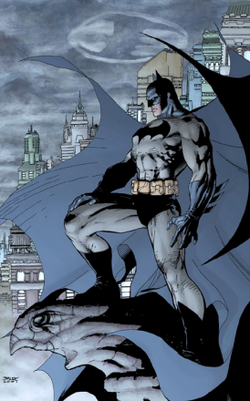
A family outing to the cinema ended in tragedy for young Bruce Wayne. Walking homeward, Bruce, his father, Thomas, and mother, Martha, accidentally ventured into Gotham City's notorious "Crime Alley" and were accosted by a mugger. Not content merely to rob the wealthy family, the hoodlum - whose identity was "never determined" - shot Dr. Thomas and Martha Wayne dead before fleeing into the darkness. As he knelt beside his parent's bodies, Bruce swore to avenge them. After the police arrived, Bruce was comforted by Dr. Leslie THompkins. Dr. Thompkins and Alfred Pennyworth helped arrange matters so that Gotham's Social Services would not take Bruce into care. In this way, both Dr. Thompkins and Alfred enabled Bruce to realize his dream of becoming a crusader against crime.


The Young Bruce Wayne
At age 14, Bruce embarked on a journey that took him to every continent as he sought to learn all the skills he would need to keep his vow. He studied criminology, forensics, and criminal psychology, and learned from manhunters and martial artists, mastering every fighting style. In time, Bruce forged himself into a living weapon to wage war on crime and injustice. On his return to Gotham, Bruce stalked street thugs as a plainclothes
vigilante. Beaten by the very people he intended to protect, he barely survived his first night out. As he sat bleeding in his study at Wayne Manor Bruce knew that he had to first strike fear in the hearts of his foes. Just then, a bat crashed through the study window, giving Bruce the inspiration he needed.

 Batman Begins
Establishing a secret headquarters in the caves beneath his mansion, Bruce became Batman, a Dark Knight to protect Gotham and its citizens from vice and villainy. Alfred Pennyworth remained his confidant, tending to injuries and offering sage advice - whether requested or not!

Batman became an urban legend, a cautionary tale that sent shivers through the city's underworld. This Caped Crusader found a friend in Captain James Gordon a Gotham cop who didn't approve of Batman's methods, but appreciated the results of his nightly crime fighting. Batman's Rogues Gallery grew to include a host of bizarre criminals, such as the Joker, Catwoman, Two-Face and the Penguin. As his enemies increased, help arrived in the form of another young boy left parentless by brutal crime.

history Of Mathematics

 history Of Mathematics


Arguably the most famous theorem in all of mathematics, the Pythagorean Theorem has an interesting history. Known to the Chinese and the Babylonians more than a millennium before Pythagoras lived, it is a "natural" result that has captivated mankind for 3000 years. More than 300 proofs are known today.


(The diagram to the left is that used by Euclid in his proof given 2300 years ago.)

Exploring the concepts, ideas, and results of mathematics is a fascinating topic. On the one hand some breakthroughs in mathematical thought we will study came as accidents, and on the other hand as consequences of attempts to solve some great open problem. For example, complex numbers arose in the study of the solution of cubic polynomials. At first distrusted and ultimately rejected by their discoverers, Tartaglia and Cardano, complex numbers were subsequently found to have monumental significance and applications.


In this course you will see firsthand many of the results that have made what mathematics is today and meet the mathematicians that created them. One particularly interesting attribute of these "builders" of mathematical structure is how clear they were about what to prove. Their results turn out to be just what is needed to establish other results sometimes in an unrelated area. What is difficult to understand for the ordinary mathematics students is just how brilliant these people were and how tenaciously they attacked problems. The personality of the greatest mathematicians span the gamut from personable and friendly to arrogant and rude.

Nonetheless, it is the mathematics that is important. For the most part we will focus on the subject itself.
How to pursue this course.